
Texas Colleges Face a Compliance Perfect Storm in 2026: Here's Your Survival Guide
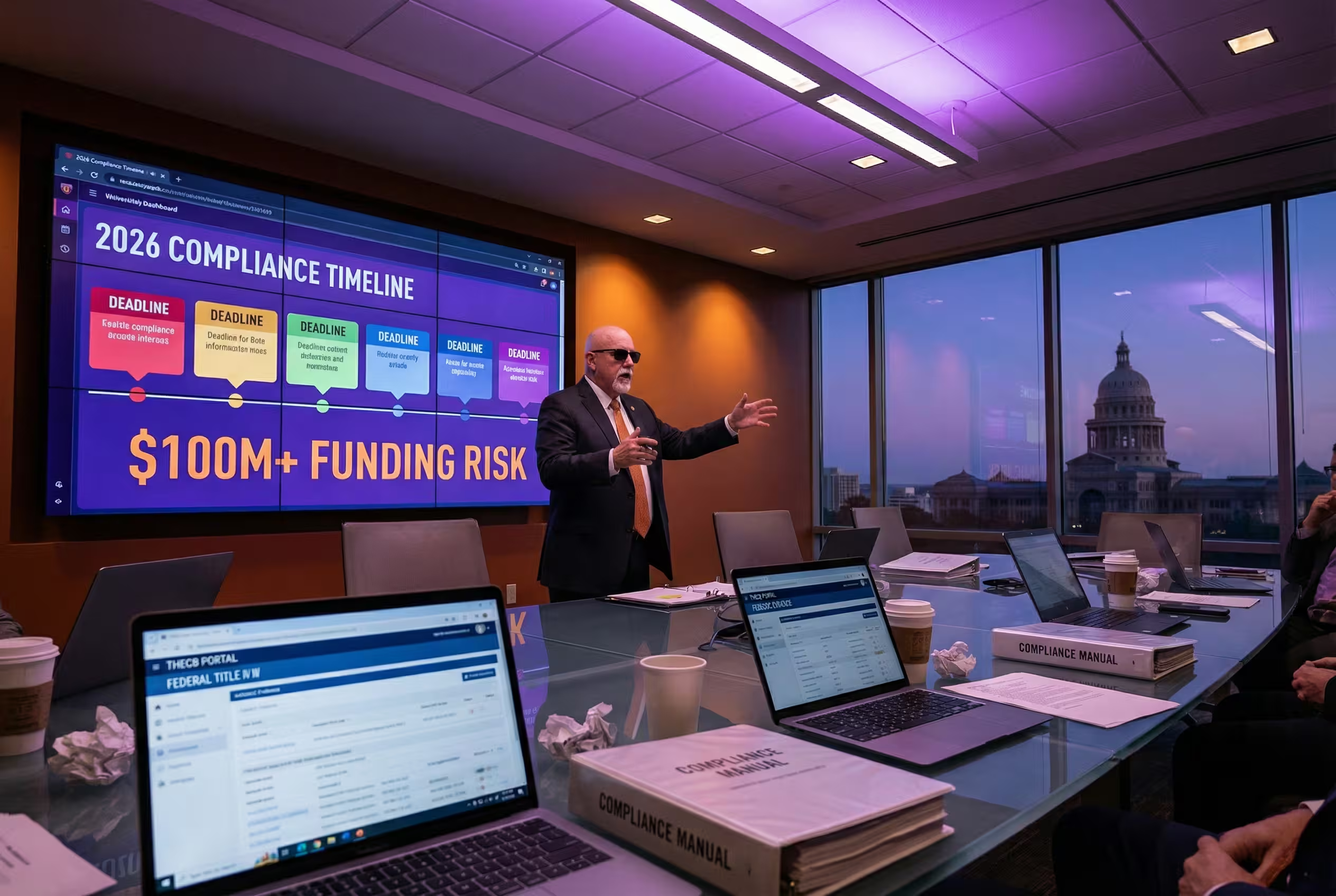
Texas colleges face an unprecedented compliance collision in 2026, with overlapping state, federal, and accreditation deadlines that put $50M–$200M+ in funding at risk. From SB 17 and HB 8 to ADA accessibility and Title IV eligibility, a single misstep can trigger cascading financial consequences. This article outlines how institutions can survive—and stabilize—in the middle of the storm.
<h2>Why This Matters</h2>
<p>Texas higher education institutions are navigating the most complex compliance landscape in U.S. higher education history—three distinct regulatory authorities with converging deadlines between January and September 2026 that could cost institutions $50M-$200M+ in lost funding.</p>
<h2>TL;DR</h2>
<p><strong>The triple compliance threat:</strong></p>
<ul>
<li><strong>State funding freeze risk:</strong> SB 17 DEI violations = 100% appropriations loss; must certify annually by Sept 1</li>
<li><strong>Federal Title IV at stake:</strong> ADA deadline April 24-26, Gainful Employment warnings July 1, $80-200M+ student aid at risk</li>
<li><strong>Performance funding pressure:</strong> Over 90% of community college state funding now tied to HB 8 outcomes, not enrollment</li>
</ul>
<p><strong>What makes 2026 unique:</strong></p>
<ul>
<li><strong>Six critical deadlines</strong> across three jurisdictions in nine months (unprecedented coordination requirement)</li>
<li><strong>Cascade failure risk:</strong> Lose accreditation → lose both state and federal funding simultaneously</li>
</ul>
<p>#HigherEdCompliance #TexasHigherEd #HB8 #TitleIV #ADAAccessibility #EnrollmentManagement</p>
<hr>
<p>It's January 2026, and you're the VP of Enrollment or CFO at a Texas college. Your calendar shows six compliance deadlines between now and September—each from a different regulatory authority, each with the potential to freeze millions in funding. Miss your SB 17 DEI certification in September? 100% state funding hold. Fail your ADA digital accessibility audit in April? Federal lawsuits and OCR investigations. Let your HB 8 performance metrics slip? Watch next year's state allocation shrink by hundreds of thousands.</p>
<p>Welcome to the compliance perfect storm.</p>
<p>This isn't hyperbole. Texas institutions in 2026 face what compliance experts are calling "the most aggressive multi-jurisdictional higher education regulatory framework in the nation." And unlike previous years where you could address compliance requirements sequentially—knock out state reporting in spring, federal submissions in fall, accreditation in reaffirmation years—2026 demands simultaneous mastery of three distinct regulatory regimes with overlapping and interdependent requirements.</p>
<p>Here's what you need to know to survive it.</p>
<h2>The Three-Headed Compliance Monster</h2>
<p>Let's be clear about what makes 2026 different: <strong>jurisdictional convergence</strong>. You're not just managing Texas state compliance OR federal requirements OR accreditation standards. You're managing all three simultaneously, and they don't play nicely together.</p>
<h3>Texas State Legislation: Performance or Perish</h3>
<p>Texas operates the most aggressive outcomes-based funding model in U.S. higher education. Here's what that means in practice:</p>
<p><strong>HB 8 (Outcomes-Based Funding Formula):</strong> Over 90% of community college state funding is now tied to performance metrics—credential completion, student milestones, workforce alignment, and transfer outcomes. Not enrollment. Not credit hours. Measurable student success.</p>
<p>The Texas Higher Education Coordinating Board (THECB) isn't subtle about this. In FY 2024, allocation variances ranged from $70,000 (Galveston Junior College) to $25 million (Alamo Colleges District)—a 357x difference driven entirely by performance. Your institution's HB 8 data submission is due April 1, 2026, and it will determine your FY 2026-2027 allocation.</p>
<p>Here's the catch: unlike the old enrollment model where you could project funding based on stable headcounts, the outcomes model creates performance volatility. Poor milestone completion this year? Lower funding next year, which reduces student support capacity, which worsens outcomes, which further reduces funding. It's a death spiral for struggling institutions.</p>
<p><strong>SB 17 (DEI Prohibition):</strong> This one's binary. Texas institutions cannot spend a single dollar of state appropriations until they submit annual certification that they've eliminated all diversity, equity, and inclusion offices, hiring requirements, and training mandates. The certification deadline is September 1, and noncompliance triggers an immediate funding freeze.</p>
<p>For a mid-size Texas public university, that's $50-75M in annual appropriations. For large systems, it exceeds $200M. There's no gradual penalty—it's zero or 100%.</p>
<p><strong>SB 1322 (Accreditation Requirements):</strong> The wild card. This 89th Legislature bill requires THECB to identify and approve accrediting agencies by September 1, 2026. If your current accreditor (likely SACSCOC for Texas institutions) isn't on the approved list, you face a nightmare scenario: comply with federal Title IV requirements (which mandate ED-recognized accreditation) or comply with Texas requirements (which may recognize different accreditors). Choose wrong, and you lose either state or federal funding.</p>
<h3>Federal Legislation: The $100M+ Exposure</h3>
<p>Federal compliance doesn't care about Texas's unique regulatory landscape. The Department of Education operates on its own timeline with its own standards.</p>
<p><strong>Title IV Federal Financial Aid:</strong> The big kahuna. For a typical mid-size Texas public university, Title IV represents $80-150M annually in federal student aid. Larger institutions exceed $200M. To maintain eligibility, you must satisfy the "Program Integrity Triad":</p>
<ol>
<li>State authorization (Texas license to operate)</li>
<li>Accreditation (ED-recognized accreditor—currently SACSCOC for most Texas institutions)</li>
<li>Federal certification (ED approval of administrative/fiscal capacity)</li>
</ol>
<p>Lose any single element, and the entire $100M+ collapses. That's the interdependency problem—your state compliance directly affects your federal eligibility.</p>
<p><strong>ADA Title II Digital Accessibility:</strong> This is the April 2026 crisis. Public institutions serving populations of 50,000+ must achieve WCAG 2.1 Level AA accessibility compliance across all digital properties by April 24, 2026. Smaller institutions get until April 26, 2027.</p>
<p>What does "all digital properties" mean? Main websites, departmental sites, student portals, online course content, mobile apps, and—here's the kicker—all third-party vendor platforms. Your LMS, your CRM, your library databases, your student information system. If it's web-based and students access it, it must be accessible.</p>
<p>Based on peer institution data shared through SACSCOC networks, institutions that successfully met April 2026 deadlines invested 1,200-2,000 professional hours in vendor coordination alone—obtaining accessibility documentation, evaluating compliance claims, negotiating remediation timelines. That's before you've fixed a single accessibility violation on your own websites.</p>
<p>And unlike state or federal funding that you lose and can potentially regain, ADA violations trigger lawsuits. Private right of action means plaintiff attorneys are already filing cases. The question isn't "Will we be compliant?" It's "How will we document good faith effort when the lawsuits arrive?"</p>
<p><strong>Gainful Employment:</strong> Effective July 1, 2026, institutions must provide warnings to current and prospective students for any career-focused program that could become ineligible based on debt-to-earnings ratios or earnings premiums. Programs failing both metrics in two out of three years lose Title IV eligibility for that specific program.</p>
<p>Here's why this matters in Texas: HB 8 incentivizes institutions to expand workforce certificate programs (credentials of value = higher state funding). But those same workforce programs are specifically targeted by Gainful Employment regulations. A single large program—nursing, allied health, skilled trades—can represent $5-10M in annual student aid. Lose Title IV eligibility for that program, and you're simultaneously losing state incentive funding for the credential.</p>
<p>It's regulatory whiplash.</p>
<h3>SACSCOC Accreditation: The Linchpin</h3>
<p>The Southern Association of Colleges and Schools Commission on Colleges serves as Texas institutions' regional accreditor. This is the linchpin—lose SACSCOC accreditation, and you simultaneously lose state authorization and federal Title IV eligibility.</p>
<p>For institutions in the 2026 reaffirmation cohort, the timeline is brutal:</p>
<ul>
<li><strong>September 8, 2025:</strong> Compliance Certification due (already passed for many)</li>
<li><strong>November 4-7, 2025:</strong> Off-Site Peer Review</li>
<li><strong>February 10, 2026:</strong> Quality Enhancement Plan (QEP) due</li>
<li><strong>Spring 2026:</strong> On-Site Committee visit</li>
<li><strong>June/December 2026:</strong> SACSCOC Board decision</li>
</ul>
<p>Miss a single deadline, and you're looking at reaffirmation deferral, which triggers state and federal funding reviews. SACSCOC doesn't care that you're also managing SB 17 certification and ADA remediation. Their timeline is their timeline.</p>
<h2>The Compliance Calendar Nightmare 📅</h2>
<p>Here's what your 2026 compliance calendar actually looks like:</p>
<table>
<thead>
<tr>
<th>Deadline</th>
<th>Requirement</th>
<th>Funding at Risk</th>
<th>Remediation Difficulty</th>
</tr>
</thead>
<tbody>
<tr>
<td><strong>Apr 1</strong></td>
<td>HB 8 performance data (state)</td>
<td>$650M+ statewide, varies by institution</td>
<td>High - requires full-year data validation</td>
</tr>
<tr>
<td><strong>Apr 24</strong></td>
<td>ADA WCAG 2.1 AA (federal, 50K+ population)</td>
<td>Litigation/OCR exposure</td>
<td>Very High - enterprise remediation</td>
</tr>
<tr>
<td><strong>Jul 1</strong></td>
<td>Gainful Employment warnings (federal)</td>
<td>$5-10M per program</td>
<td>Medium - disclosure requirement</td>
</tr>
<tr>
<td><strong>Sep 1</strong></td>
<td>SB 17 DEI certification (state)</td>
<td>100% state appropriations ($50-200M+)</td>
<td>Low - binary compliance</td>
</tr>
<tr>
<td><strong>Sep 1</strong></td>
<td>THECB accreditor approval (state)</td>
<td>State funding if accreditor not approved</td>
<td>High if transition required</td>
</tr>
</tbody>
</table>
<p>Notice the problem? April through September gives you five months to execute on requirements that each demand months of preparation. And that's assuming nothing goes wrong.</p>
<h2>What This Actually Costs</h2>
<p>Let's talk numbers. Not scare tactics—actual institutional economics.</p>
<h3>Small Community Colleges (Under 2,500 FTE)</h3>
<p><strong>Typical staff structure:</strong> 2-4 administrators managing financial aid, institutional research, compliance, and strategic enrollment. HB 8 reporting, SB 17 certification, and ADA remediation represent an estimated 25-40% workload increase in 2025-2026.</p>
<p><strong>The opportunity cost calculation:</strong> If your institutional research director spends 30% of their time on compliance reporting versus strategic analysis, and compliance automation could reduce that to 10%, you've freed 20% of a key staff member's capacity. For a small institution where one additional enrollment counselor can generate 20-30 enrollments ($200K-$400K in tuition plus fees), that freed capacity justifies significant compliance infrastructure investment.</p>
<p><strong>HB 8 funding volatility risk:</strong> A $2M annual allocation with 10% performance decline = $200K annual loss. Automated milestone tracking that improves performance by 5-10%? That's $100-200K in recovered or protected funding.</p>
<h3>Mid-Size Universities (5,000-15,000 Students)</h3>
<p><strong>ADA remediation project:</strong> Based on our environmental scans with Texas institutions, mid-size universities average 35-50 third-party software vendors. Comprehensive WCAG 2.1 AA remediation costs $50-150K for enterprise audit plus implementation. Internal IT staff time: 200-500 hours.</p>
<p><strong>HB 8 data integrity:</strong> In our CRM-SIS integration projects with Texas community colleges, we consistently find 10-25% data discrepancies in student milestone tracking when automated connections replace manual exports. For a mid-size institution with $3-5M in HB 8 annual allocation, that's $300K-$1.25M in potential funding at risk from data errors.</p>
<h3>Large Public Universities (15,000+ Students)</h3>
<p><strong>Title IV dependency:</strong> $200M+ in federal student aid. A Title IV suspension—even temporary—creates existential crisis. Compliance infrastructure investments that protect nine-figure funding streams justify seven-figure prevention costs.</p>
<p><strong>Decentralized complexity multiplier:</strong> Large publics operate 8-15 independent colleges/schools, each with separate technology procurement and compliance accountability. Without central coordination, you're duplicating effort 8-15x. Unified compliance dashboards and vendor management systems create enterprise efficiency.</p>
<h2>What This Looks Like by Segment</h2>
<h3>Community Colleges: The HB 8 Optimization Imperative</h3>
<p>You face the highest stakes in Texas higher education—90%+ of your state funding depends on performance metrics you're tracking in systems that don't talk to each other.</p>
<p><strong>The problem:</strong> Your SIS knows when students earn credits. Your financial aid system knows who's Pell-eligible (economically disadvantaged = HB 8 bonus). Your advising system knows who's academically underprepared. But these systems don't share data in real-time, so advisors don't know which students are behind on 15-credit milestones until it's too late to intervene.</p>
<p><strong>The solution:</strong> Real-time milestone tracking with automated advisor alerts. When a Pell-eligible first-year student hits spring semester with only 9 credits, an automated alert triggers proactive outreach. The intervention window is months, not weeks.</p>
<p>Based on our client work with Texas community colleges, institutions with real-time HB 8 dashboards intervene on at-risk students 3-5 months earlier than institutions relying on annual THECB reports. That timing difference is the margin between meeting performance targets and watching funding decline.</p>
<p><strong>ROI:</strong> Our Texas community college CRM-SIS integration projects have generated $300K-$800K in incremental HB 8 funding in year one (client-reported outcomes). That's not theory—that's actual institutions reporting actual funding increases after implementing automated milestone tracking.</p>
<h3>Regional Universities: The ADA-SACSCOC Squeeze</h3>
<p>You're caught between enterprise-level compliance obligations (ADA, accreditation) and mid-size resource constraints.</p>
<p><strong>The problem:</strong> Limited IT staff (8-12 FTE managing all enterprise systems, vendor relationships, and now ADA remediation). A 1,200-2,000 hour accessibility project represents 50-80% of annual IT capacity. And you're simultaneously managing SACSCOC reaffirmation documentation, which requires evidence compilation across every academic unit.</p>
<p><strong>The solution:</strong> External partnership that provides enterprise-level expertise without enterprise-level headcount costs. You don't need to hire a full-time accessibility specialist and a full-time accreditation coordinator. You need project management expertise that accelerates timeline from 12-18 months (typical DIY approach) to 6-9 months (managed implementation).</p>
<p><strong>What to prioritize first:</strong></p>
<ol>
<li><strong>Q1 2026 (Immediate):</strong> Conduct comprehensive ADA audit; obtain VPAT documentation from all vendors</li>
<li><strong>Q2 2026:</strong> Implement high-priority accessibility remediations; finalize SACSCOC evidence documentation</li>
<li><strong>Ongoing:</strong> Establish vendor accessibility procurement standards to prevent future violations</li>
</ol>
<h3>Large Public Universities: Integration Orchestration at Scale</h3>
<p>Your challenge isn't technical capacity—you have IT staff. Your challenge is coordination across fragmented systems and decentralized colleges.</p>
<p><strong>The problem:</strong> Individual colleges procure their own technology. Student Success uses different tools than Engineering than Business School. No one has enterprise visibility into which vendors are accessibility compliant. Compliance reporting requires manual data extraction from 10+ systems.</p>
<p><strong>The solution:</strong> Unified compliance dashboards integrating state, federal, and accreditation requirements with cross-functional accountability tracking. Not another software platform—integration architecture that connects what you already own.</p>
<p><strong>What this looks like in practice:</strong> Your Provost Office sees real-time HB 8 milestone performance across all colleges. Your CIO sees vendor accessibility compliance status and VPAT documentation centrally. Your CFO sees cascade failure risk modeling ("If we lose accreditation, here's the combined state + federal funding loss in a single view").</p>
<h3>Private Institutions: Title IV Protection and ADA Urgency</h3>
<p>You don't face SB 17 or HB 8 (non-state-funded), but you face maximum Title IV dependency and immediate ADA litigation risk.</p>
<p><strong>The problem:</strong> 60-80% of your total revenue comes from tuition supported by federal Title IV student aid. Public institutions have diversified revenue (state appropriations, research funding, endowments). You live and die on enrollment and federal aid eligibility.</p>
<p>And unlike public institutions with April 2026 ADA grace period, you face immediate litigation risk. There's no federal deadline protecting you. Plaintiff attorneys filed over 4,000 ADA Title III web accessibility lawsuits in 2023 against private entities. Higher education is a target-rich environment.</p>
<p><strong>The solution:</strong> Treat ADA compliance as immediate priority (not 2027 planning), and model Title IV "stress tests" to understand enrollment decline tolerance before you hit financial crisis.</p>
<p><strong>ROI framing:</strong> ADA remediation is insurance with measurable payoff. A consent decree costs $100K-$1M in legal fees plus 2-3 years of OCR oversight. Proactive remediation ($50-150K) is the cheaper path, and it eliminates litigation risk that could tank your enrollment pipeline (prospective students Google your lawsuits).</p>
<h2>The Build vs. Buy Decision</h2>
<p>Let's address the question you're really asking: Can we handle this internally, or do we need external help?</p>
<p>Here are the decision signals:</p>
<p><strong>You can probably handle compliance internally if:</strong></p>
<ul>
<li>You have dedicated full-time compliance staff (not people with "compliance plus six other responsibilities")</li>
<li>Your IT department includes staff with CRM-SIS integration experience and accessibility expertise</li>
<li>Your institutional research office can generate real-time HB 8 performance forecasts (not just retrospective annual reports)</li>
<li>You have 12-18 months to execute ADA remediation (not 4-6 months)</li>
<li>Compliance consumes less than 30% of key administrative staff time</li>
</ul>
<p><strong>You likely benefit from external partnership if:</strong></p>
<ul>
<li>Compliance falls on people with competing full-time operational responsibilities</li>
<li>You're managing compliance across three jurisdictions without unified tracking</li>
<li>Your systems don't talk to each other (SIS, CRM, financial aid, LMS, advising all operating in silos)</li>
<li>ADA April 2026 deadline requires compressed 4-6 month remediation timeline</li>
<li>When compliance failures risk $10M+ in annual funding (making professional help insurance, not expense)</li>
</ul>
<p><strong>The specific expertise gaps where partnerships add measurable value:</strong></p>
<ol>
<li><strong>HB 8 milestone tracking architecture</strong> - Connecting SIS student records to CRM with automated early-warning workflows</li>
<li><strong>Multi-platform integration for compliance data</strong> - Building audit trails and data validation for reporting accuracy</li>
<li><strong>Vendor accessibility management</strong> - Coordinating 35-50 third-party vendors for VPAT documentation and remediation</li>
<li><strong>Compliance workflow automation</strong> - Creating processes that survive staff turnover</li>
</ol>
<p>These aren't generic IT projects. They require higher education domain expertise—understanding THECB HB 8 methodology, SACSCOC evidence standards, and Title IV compliance nuances. Your internal IT team handles technical implementation beautifully, but they may not know that "economically disadvantaged" in HB 8 context means specific Pell eligibility thresholds, or that SACSCOC substantive change reporting has 30-90 day lead time requirements.</p>
<p>That's where partnership delivers ROI.</p>
<h2>Economics & ROI: The Real Numbers</h2>
<p>Let's quantify what we've been discussing.</p>
<p><strong>HB 8 Data Integrity ROI:</strong> Mid-size Texas community college with $2M annual HB 8 allocation. Automated SIS-CRM integration costs $40-60K (implementation) plus $8-12K annual maintenance. If integration eliminates 10% data discrepancy (conservative estimate based on our client projects), you've protected $200K in funding. Payback period: 3-4 months. Five-year ROI: 250-600x.</p>
<p><strong>ADA Remediation Cost Avoidance:</strong> Proactive enterprise accessibility remediation costs $50-150K. ADA consent decree with OCR investigation costs $100K-$1M in legal fees plus remediation costs plus 2-3 years of monitored compliance. Proactive path costs 10-50% of reactive path. Plus you eliminate lawsuit risk that damages institutional reputation and prospective student trust.</p>
<p><strong>Staff Capacity Liberation:</strong> If compliance automation reduces institutional research director's compliance burden from 30% to 10% of time, you've freed 20% capacity (approximately 400 hours annually). If that time generates even one strategic enrollment initiative that yields 15-20 additional enrollments, you've created $150-300K in tuition revenue. Compliance automation isn't a cost center—it's revenue enablement.</p>
<p><strong>The cascade failure prevention value:</strong> This one's harder to quantify but critical to understand. What's the cost of losing accreditation? You simultaneously lose state funding + federal Title IV + institutional credibility. For a mid-size institution, that's $50M (state) + $100M (federal) = $150M annual revenue loss. Compliance infrastructure that prevents cascade failure isn't expense—it's catastrophic risk mitigation.</p>
<h2>The Questions You Should Be Asking Right Now</h2>
<p>Forget generic "audit your funnel" advice. Here are the diagnostic questions that actually reveal whether you're prepared for 2026's compliance storm:</p>
<p><strong>Multi-jurisdictional coordination:</strong></p>
<ul>
<li>Can you show me a single calendar with all state, federal, and accreditation deadlines for 2026 with accountable owners and status tracking?</li>
<li>If your THECB liaison or accreditation coordinator leaves tomorrow, is compliance knowledge documented or in someone's head?</li>
<li>Do you have automated alerts for compliance deadlines, or do you rely on staff memory?</li>
</ul>
<p><strong>Data infrastructure:</strong></p>
<ul>
<li>How many different systems do you export data from to complete HB 8 reporting? (If the answer is "three or more," you have integration opportunity.)</li>
<li>Can you generate a real-time forecast of your HB 8 funding for FY 2027 based on current student cohort performance? (If no, you're managing with 6-9 month lag.)</li>
<li>Have you ever discovered after-the-fact that reported compliance data was wrong? What was the impact?</li>
</ul>
<p><strong>ADA readiness:</strong></p>
<ul>
<li>Do you have a centralized list of all third-party software vendors and their accessibility compliance status?</li>
<li>Have you obtained VPAT documentation from all vendors?</li>
<li>Does your procurement approval process include accessibility review as a gate (not a post-purchase problem)?</li>
</ul>
<p><strong>Resource allocation:</strong></p>
<ul>
<li>What percentage of your institutional research director's or compliance officer's time is spent on compliance reporting versus strategic analysis?</li>
<li>If compliance obligations disappeared tomorrow, what would your team focus on instead? (The answer reveals opportunity cost.)</li>
<li>Have you modeled what happens if you lose just one major compliance requirement—SB 17 state funding freeze, Title IV suspension, or SACSCOC warning status?</li>
</ul>
<p>The institutions that survive 2026's compliance perfect storm aren't the ones with the biggest budgets. They're the ones asking these questions now—in January, not July.</p>
<h2>What We've Learned From the Trenches</h2>
<p>Here's what 40+ conversations with Texas enrollment leaders and multiple community college integration projects have taught us:</p>
<p><strong>Lesson 1: Compliance fragmentation is the silent budget killer.</strong> Institutions spend 40-60% more on compliance than they realize because the costs are distributed across multiple departments (IT, IR, financial aid, legal, HR). No one sees the total picture. When you centralize compliance visibility, CFOs consistently discover they're spending $200-400K annually on duplicated effort.</p>
<p><strong>Lesson 2: The institutions that waited for "more budget" missed the intervention window.</strong> ADA compliance, HB 8 milestone tracking, Gainful Employment monitoring—these all have optimal intervention windows. Start ADA remediation in January 2026 for April deadline? You're in crisis mode paying premium costs for compressed timelines. Start in July 2025? You have comfortable 9-month runway with lower costs and better outcomes.</p>
<p><strong>Lesson 3: Staff turnover is the compliance killer you're not planning for.</strong> Every institution we've worked with has lost key compliance knowledge to turnover. The compliance coordinator who held the SACSCOC reaffirmation timeline in their head leaves for another institution, and you're starting from zero. Compliance infrastructure that survives turnover (documented workflows, automated calendars, integrated systems) is institutional resilience insurance.</p>
<p><strong>Lesson 4: Vendor accessibility compliance is a supply chain management challenge.</strong> You can fix your own websites in 6 months. Coordinating 35-50 third-party vendors to provide VPAT documentation, remediate violations, and maintain ongoing accessibility? That's 12-18 months even for well-resourced IT departments. Treating ADA as a technical problem underestimates the project management complexity.</p>
<p><strong>Lesson 5: Real-time HB 8 tracking changes institutional behavior.</strong> When advisors see automated alerts that a Pell-eligible student is behind on milestones, they intervene. When leadership sees real-time funding forecasts showing performance trends, they allocate resources to student success initiatives. You can't manage what you can't measure in real-time.</p>
<h2>What Happens Next</h2>
<p>You have two paths forward.</p>
<p><strong>Path 1: Reactive Crisis Management</strong><br>
Wait until compliance deadlines loom. Pull staff from operational duties to handle crisis response. Submit data you hope is accurate. Cross fingers that audit findings don't trigger multi-cycle remediation. Repeat annually.</p>
<p>This path costs more in the long run—not just in dollars (reactive remediation is 2-5x more expensive than proactive infrastructure), but in staff burnout, institutional reputation risk, and lost funding from preventable compliance gaps.</p>
<p><strong>Path 2: Proactive Compliance Infrastructure</strong><br>
Build unified compliance calendaring across jurisdictions. Integrate systems so data flows automatically with audit trails. Automate workflows that survive staff turnover. Create real-time dashboards that turn compliance from reporting obligation into strategic enrollment tool.</p>
<p>This path requires upfront investment, but it pays dividends for years. And critically—it protects the nine-figure funding streams your institution depends on.</p>
<h2>The Real Question</h2>
<p>Here's the question that matters: What's the cost of getting this wrong?</p>
<p>Not "What does compliance infrastructure cost?" but "What happens if we lose SB 17 certification and our state funding freezes for 3 months while we remediate?" or "What's the institutional impact of a Title IV suspension that cuts off $100M in federal student aid mid-semester?"</p>
<p>When you frame compliance as catastrophic risk mitigation rather than administrative burden, the ROI calculation changes dramatically.</p>
<p>We've helped Texas institutions build HB 8 milestone tracking that generated $300K-$800K in incremental funding in year one. We've coordinated ADA remediation projects that eliminated litigation exposure and OCR investigation risk. We've created compliance dashboards that transformed compliance from "thing we have to do" into "strategic advantage over less-prepared competitors."</p>
<p>That's not consulting revenue. That's partnership outcomes.</p>
<h2>Summary</h2>
<p>Texas higher education in 2026 is navigating unprecedented compliance complexity—three regulatory jurisdictions (state, federal, accreditation) with converging deadlines between January and September. The stakes are existential: SB 17 DEI violations freeze 100% of state appropriations; Title IV suspensions eliminate $80-200M+ in federal student aid; SACSCOC accreditation loss triggers cascade failure of both funding streams.</p>
<p>Community colleges face maximum pressure from HB 8's outcomes-based funding (90%+ of state allocation tied to performance). Regional universities struggle with enterprise compliance obligations on mid-size budgets. Large publics wrestle with coordination across decentralized colleges. Private institutions face Title IV dependency and immediate ADA litigation risk.</p>
<p>The institutions that survive aren't the ones with the biggest budgets—they're the ones with integrated compliance infrastructure, real-time performance tracking, and partnership models that provide enterprise expertise without enterprise headcount costs.</p>
<p><strong>The question isn't whether compliance is expensive. It's whether non-compliance is survivable.</strong></p>
<p>Want to see where your compliance infrastructure has gaps before the April-September crunch? Let's have that conversation now, not in crisis mode this summer.</p>
<h2>References</h2>
<ul>
<li><a href="https://capitol.texas.gov/tlodocs/88R/billtext/html/SB00017F.htm">Texas Education Code §51.3525 (SB 17 - DEI Prohibition)</a> - Texas Legislature (2023)</li>
<li><a href="https://capitol.texas.gov/BillLookup/History.aspx?LegSess=88R&Bill=HB8">Texas HB 8 - Community College Outcomes-Based Funding</a> - Texas Legislature (2023)</li>
<li><a href="https://www.highered.texas.gov/community-college-finance/formula-funding/">THECB Formula Funding Guidelines</a> - Texas Higher Education Coordinating Board (2024)</li>
<li><a href="http://www.txhighereddata.org/60x30TXProgress">Texas 60x30TX Progress Report</a> - Texas Higher Education Data (2024)</li>
<li><a href="https://www.federalregister.gov/documents/2023/10/10/2023-21352/financial-value-transparency-and-gainful-employment">34 CFR 668.403 - Gainful Employment Final Rule</a> - Federal Register (2023)</li>
<li><a href="https://www.federalregister.gov/documents/2025/01/03/2024-31031/program-integrity-and-institutional-quality-distance-education-and-return-of-title-iv-hea-funds">28 CFR 35.200 - ADA Title II Digital Accessibility Final Rule</a> - Federal Register (2024)</li>
<li><a href="https://www.w3.org/WAI/WCAG21/quickref/">WCAG 2.1 Level AA Technical Standard</a> - World Wide Web Consortium (W3C)</li>
<li><a href="https://sacscoc.org/accrediting-standards/">SACSCOC Principles of Accreditation 2024 Edition</a> - SACSCOC (effective January 1, 2024)</li>
<li><a href="https://www.congress.gov/crs-product/R43159">Higher Education Act Title IV</a> - Congressional Research Service</li>
<li><a href="https://www.edexcelencia.org/research/publications/2023-24-emerging-hsis">Excelencia in Education HSI Data Fall 2023</a> - Excelencia in Education</li>
<li><a href="https://www.nacubo.org">NACUBO Higher Education Technology Benchmarking Report 2024</a> - National Association of College and University Business Officers (member portal)</li>
<li><a href="https://agb.org/news/agb-alerts/agb-policy-alert-ada-digital-accessibility-rule-requires-full-compliance-by-april-2026/">AGB Policy Alert: ADA Digital Accessibility Compliance April 2026</a> - Association of Governing Boards (2025)</li>
</ul>
<hr>
<p><strong>Note:</strong> ROI figures and client outcomes ($300K-$800K incremental HB 8 funding, 10-25% data discrepancy rates, 3-5 month earlier intervention timelines) are based on StudentSignal client-reported results and proprietary project data from Texas community college implementations. These represent actual institutional experiences, not theoretical projections.</p>
<p><strong>About StudentSignal:</strong> We partner with Texas colleges and universities to build enrollment technology infrastructure that protects funding and enables growth. Our CRM integration, data services, and compliance automation solutions are designed for institutions that want enterprise outcomes without enterprise headcount costs. We don't sell hours—we deliver enrollment outcomes.</p>
Find Your Compliance Gaps Before 2026 Finds You
Six deadlines. Three regulators. Nine months. We’ll help you pinpoint where funding, accreditation, or ADA risk is hiding—while there’s still time to fix it.